Description
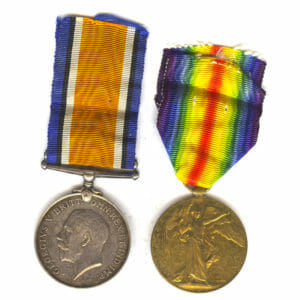
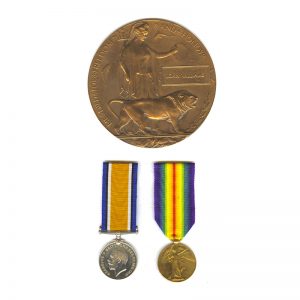
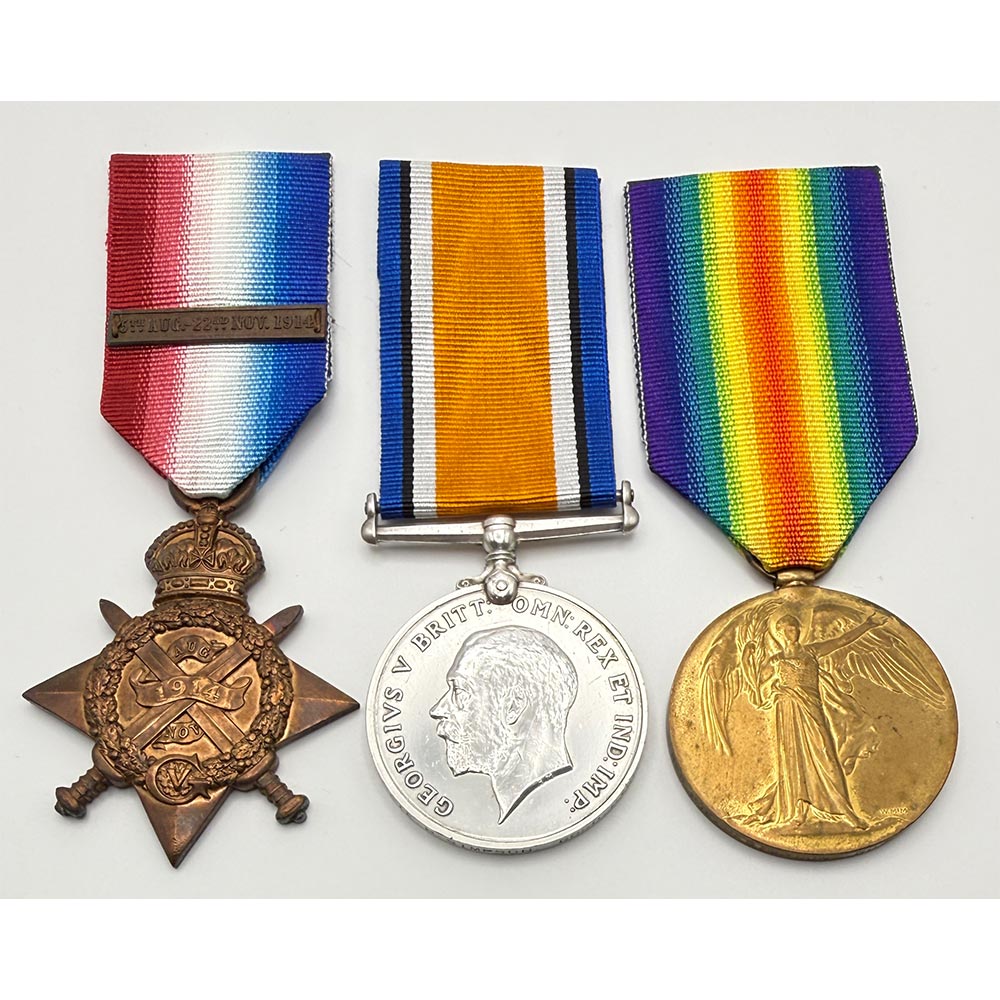
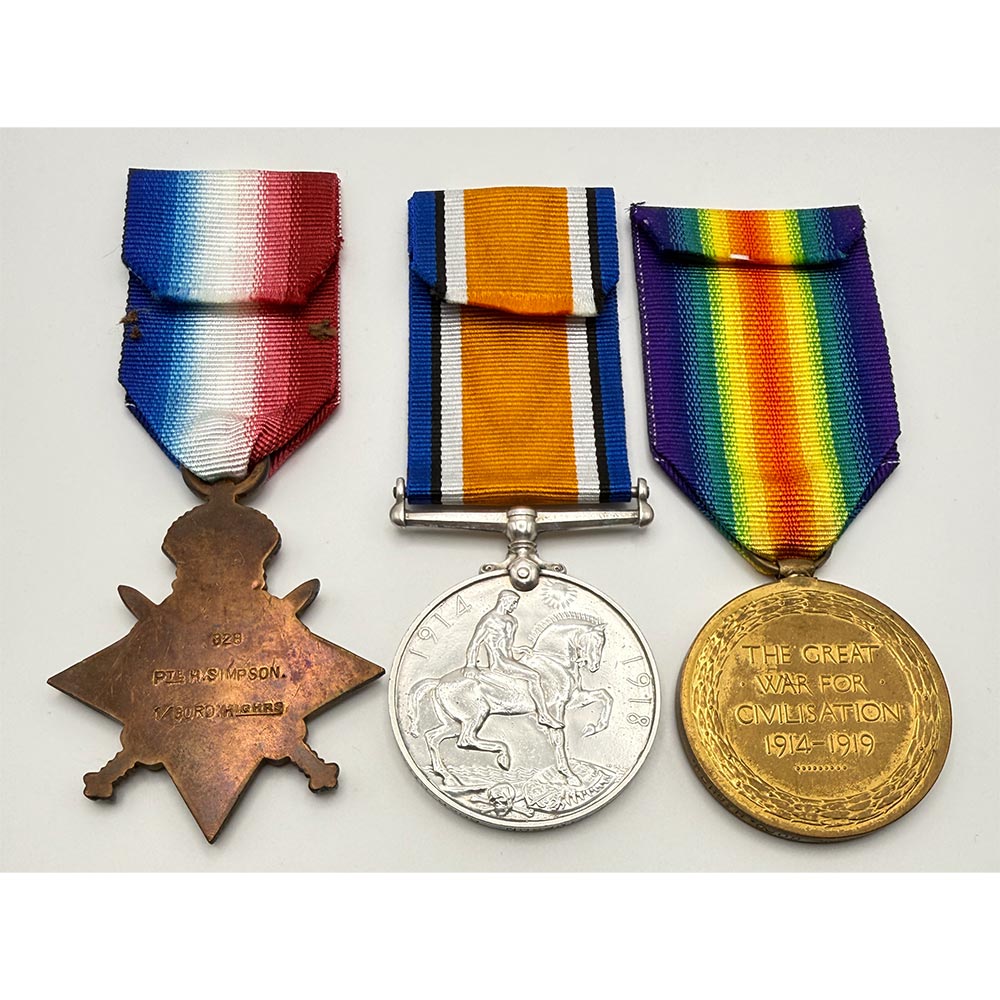
1914 Star with original clasp ‘5th Aug – 22nd Nov 1914’, British War & Victory Medal, 828 Private Henry Simpson, 1st Bn Gordon Highlanders, who landed on 13th August 1914 soon after taken Prisoner and died in Germany.
1914 Star officially impressed: “828 Pte H. Simpson. 1/Gord. Highrs”
Pair officially impressed: “828 Pte H. Simpson. Gord. Highrs.”
Henry was officially declared as missing when his regiment was almost decimated early into the war, joining many of his fellow 1st Bn men as Prisoners of War, being taken back to Germany.
Only a few days into the war, the men were left in disarray in the retreat from Mons, at 2am on 27th August 1914 they were misled by a German Spy leading to hundreds of them being captured and sent to Germany. In total 496 unwounded Prisoners were captured.
He did not however survive the captivity, having died of “consumption” at Lippspringe, where there was the German Hospital Lazarett.
Henry Simpson was a Scotsman born in the historic village of Auchterless, Aberdeenshire on 8th September 1892. The quiet village has only ever had a population of around 1000.
Henry signed on for the Army at Turriff his service number suggests around 1911, and was part of the “Old Contemptibles” who were the first to land to fight in France.
He disembarked with the first wave of the 1st Bn Gordon Highlanders in France on 13th August 1914.
The regiment was then put through the gauntlet almost immediately.
The next information given was when the newspapers on 30th October 1914 published a massive list dated 20th September 1914 showing “Gordon Highlanders Casualties, Earlier Battles of the War, List of Missing men”
Hundreds of 1st Bn Men has gone missing in action including Pte Simpson, having mostly been sent back to Germany.
These men were actually almost all captured on 26th August 1914, that night on the 26-27th August, the regiment was at Bertry following fighting at Le Cateau when the men were forced into a retreat, having been offered to be guided by a local civilian, who turned out to be a Spy for the Germans, the 1st Bn was all but surrounded and taken prisoner.
The personal account of “Teddy Trueland” a fellow 1st Bn Gordon Highlander captured on the day recalls the services of the men and capture:
“Fighting? No, I didn’t see much of that. I was only four days under fire when I was captured.
“I was called up on the 5th August, and reported to Aberdeen. Next day the 1st Gordon Highlanders, to which I had been appointed, left for Plymouth, and we reached Mons on August 21. We took part in the great retreat from Mons, fighting rearguard actions all the time amidst the German shells.
“At 2 a. m. on the 27th August we had covered a great deal of ground, when we arrived at a cross road, where we halted. Here a civilian offered to show us the way, but when he came to a certain point he refused to go on.
“We had gone about 60 yards further when we were startled by shots in the darkness. Eventually we discovered that we had been trapped. The civilian was a spy. The Germans surrounded us. We had to drop our rifles and put our hands up above our heads while we were searched. The search occupied a long time. Never before have I felt my arms so tired.”
GERMAN CAPTIVITY
The men were taken to Sennelager Camp, a massive camp for Prisoners of War being captured as the war began, nearby was the Spa Town of Lippspringe, where men such as Pte Simpson were sent to recover, as conditions were poor, the men were given scarcely any decent food, were overcrowded and overworked a number of them died.
Henry officially died on 13th March 1915 in Germany at Lippspringe, where the tireless British Army Doctor Captain Robert Cahill DSO RAMC tended to sick Prisoners of War there.
It was not reported back home until the details were passed from the German Government about August 1915.
Bad Lippspringe was a specialised Military Hospital, where sick British Prisoners of War were sent for treatment.
It was a famous spa town so many Tuberculosis patients were sent there for respiratory illnesses, his death by “Consumption” was the old reference for TB.
In an article on Scottish Prisoners of War for National Records Scotland they recall an almost identical story of George Duff, a fellow 1st Bn Gordon Highlanders who died 10 days earlier of the same cause.
https://www.nrscotland.gov.uk/learning-and-events/first-world-war/scottish-prisoners-of-war-1914-1918/
They write:
“In addition to their diet British prisoners of war had a better chance of survival when Allied medical personnel were present to help them as required. The rule was that captured medical officers be returned to their own side as soon as possible, but the Germans found them useful and were slow to comply. Thus Royal Army Medical doctors found themselves battling against the effects of the poor conditions in many camps. After being captured on 11 September 1914, Captain Robert Cahill RAMC tended to sick prisoners at the German hospital (‘Lazarett’) at Lippspringe. On 5 March 1915 he wrote out and witnessed the will of one of his dying patients, a Gordon Highlander. Later that day Private George Duff died of phthisis, a form of tuberculosis. In June 1915 Cahill was part of an exchange of prisoners between the British and Germans. He continued as an army doctor, and was awarded the Distinguished Service Order (DSO) for his wartime service.”
Henry was mentioned in the 2016 Article for the “Bad Lippspringe Historical Society” titled “Their Name Liveth for Evermore” by Von Hans-Christian Schall.
Schall took an interest in 3 Scotsman who died far from home in Germany.
Schall takes photographs of the graves of the 3 Scotsmen who died and were buried there, the above mentioned George Duff was one of them, as well as Henry Simpson and Lance Corporal Laurence O’Driscoll of the KOSB.
Schall writes that the men were captured having been left behind in the retreat from Mons, being brought to Germany and sent to the Prisoner of War camp at Stamuhle in the Senne District.
He notes that the men were quite popular upon arrival, the locals of Westphalia were most interested in the men still wearing their traditional kilted uniform.
However the winter was brutal on the men, due to the conditions in the camp, as well as the rigours of the war many fell ill.
In particular those such as Private Simpson were sent to the Schutzenhalle (Shooting Association Hall) at Bad Lippspringe, a newly built building constructed in 1912 and requisitioned by the Army.
In total throughout the war about 100 men were to die in Bad Lippspringe, Simpson was originally buried in the nearby Dorenkamp Prisoner of War Cemetery, before being moved by the CWGC to the new cemetery at Kassel-Niederzwehren where he rests today.