Description
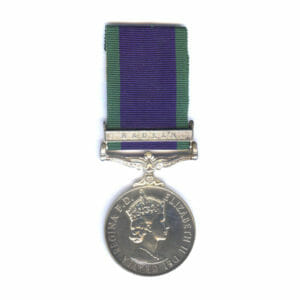
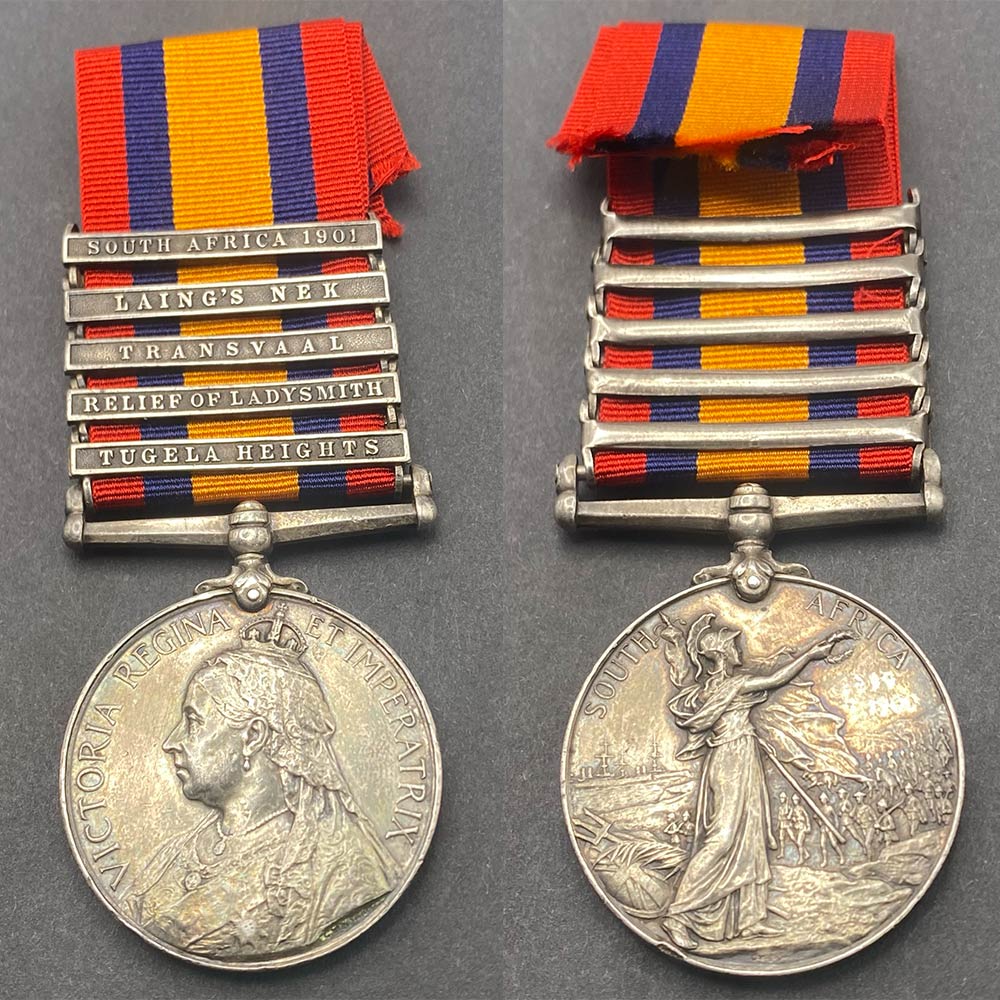
Queen’s South Africa, 5 clasps, Tugela Heights, Relief of Ladysmith, Transvaal, Laing’s Nek, SA 1901, 6249 Private George Jones, 2nd Bn Scottish Rifles.
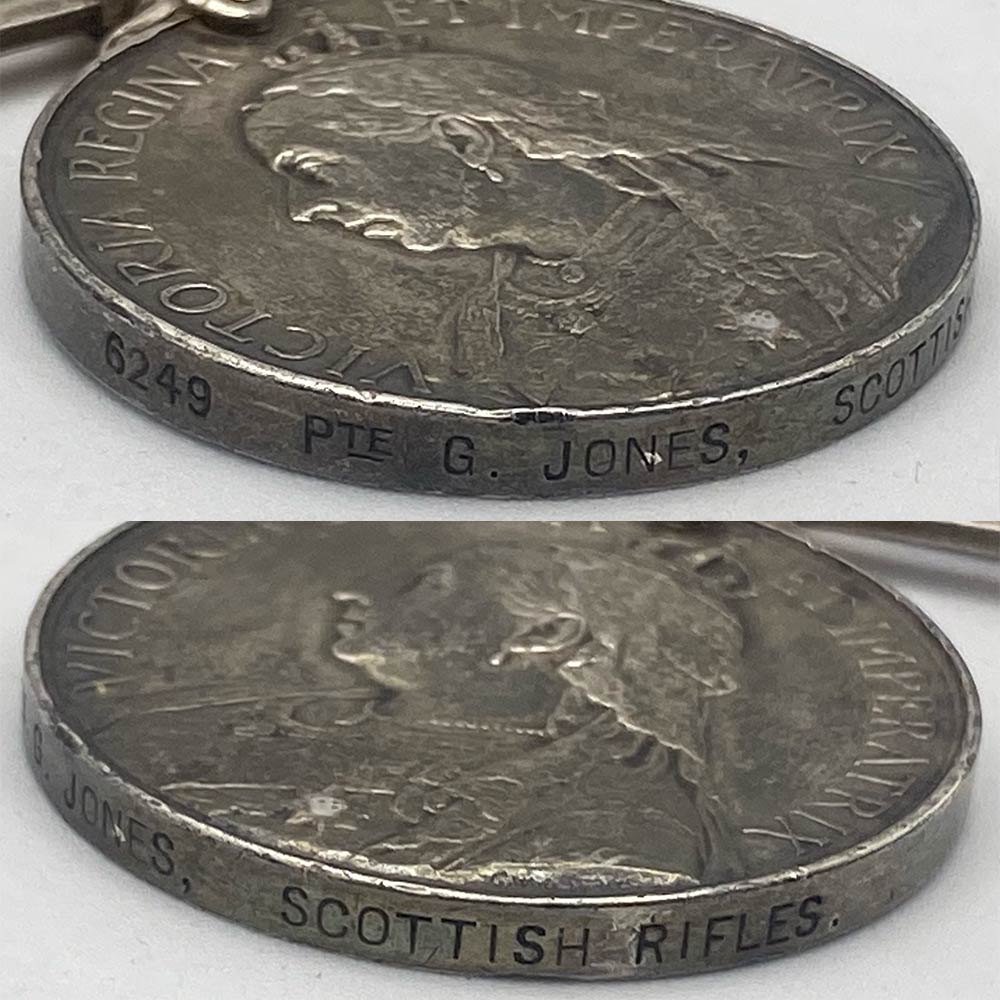
Officially impressed: “6249 Pte G. Jones, Scottish Rifles”
Visible ghost dates on reverse.
George Jones, was born in Harpurhey, Lancashire during 1880.
He attested for service with the Cameronians aka Scottish Rifles having freshly turned 18 on 14th September 1898.
He had worked as a Stoner Polisher and was serving in the Militia with the 3rd Bn King’s Own.
He would see the following service:
Home, 14th September 1898 – 31st December 1899
South Africa (Boer War), 1st Jan 1900 – 31st May 1902
Home, 1st June 1902 – 3rd Nov 1902
South Africa, 4th Nov 1902 – 27th May 1904
Home, 28th May 1904 – 13th September 1915.
After the Boer War he returned home to by transferred to the Army Reserve from 13th September 1906, due to this he was remobilised at Hamilton on 5th August 1915 and posted to the depot on 8th August 1914 with the outbreak of the First World War.
He was discharged on 13th September 1915 without seeing active service “on termination of his 1st period of engagement” having completed 17 years.
The services of the 2nd Bn Scottish Rifles in the Boer War is well told on Angloboerwar.com at the following page:
https://www.angloboerwar.com/unit-information/imperial-units/cameronians-scottish-rifles
In brief, as one of the early arrivals into the war in November 1899 they joined the 4th Brigade under Major General Lyttleton. Being present at Colenso in December they took part in the “Tugela Heights” related fighting notably becoming part of the “Relief of Ladysmith”, where they fought at Spion Kop, Vaal Krantz, Pieter’s Hill and Laing’s Nek.
The regiment would distinguished themselves particularly at Spion Kop, fighting its way to the summit whilst taking casualties fighting alongside the 60th Rifles.
General Buller would write in his despatch: “Our men fought with great gallantry, and I would specially mention the conduct of the 2nd Scottish Rifles and 3rd King’s Royal Rifles, who supported the attack on the mountain from the steepest side, and in each case fought their way to the top, and the 2nd Lancashire Fusiliers and 2nd Middlesex, who magnificently maintained the best traditions of the British army; and Thorneycroft’s Mounted Infantry, who fought throughout the day equally well alongside of them”